
Shaving looks simple, but at a microscopic level it is a surprisingly complex process. A razor must cut tough hair fibres while sliding across delicate skin without causing damage. The reason modern razors can do this successfully lies in a combination of physics, biology, and engineering. Understanding the science behind shaving helps explain why some razors feel smooth and effortless while others cause irritation, razor burn, or nicks despite appearing sharp.
Human hair is stronger than most people realise. Each hair strand is made of keratin, a tough protein that resists cutting. At the same time, skin is soft, elastic, and sensitive to friction. The challenge for a razor is to apply enough force to cut hair cleanly while distributing that force in a way that avoids scratching or scraping the skin. This balance is achieved through sharpness, blade geometry, lubrication, and controlled pressure.
Sharpness is the foundation of effective shaving. A sharp blade cuts hair cleanly at the surface instead of bending or pulling it. When a blade is dull, hair resists being cut and the razor tugs at it, transferring force into the skin. This pulling action is one of the main causes of discomfort and irritation. Contrary to intuition, sharper blades are actually safer because they require less pressure to cut hair efficiently.
Blade geometry also plays a critical role. Razor blades are ground to an extremely fine edge at a specific angle that allows them to slice hair rather than crush it. This slicing action reduces resistance and limits the force needed for cutting. If the blade angle is incorrect, the blade scrapes the skin or struggles to engage the hair properly. Well-engineered cartridges maintain consistent blade geometry across the entire shaving surface, even as the razor moves over curved areas of the face.
Lubrication is the next essential element. Even the sharpest blade would irritate skin if dragged across it without protection. Shaving creams, gels, and foams soften hair and create slip, reducing friction between the blade and the skin. Modern cartridge razors enhance this further with lubrication strips that deposit a thin layer of glide directly in the blade’s path. This lubrication allows the blade to move smoothly, reducing micro-abrasions that lead to redness and burning.
Skin behaviour during shaving is another part of the science. Skin is elastic, meaning it stretches slightly when pressure is applied. Razor guards gently stretch the skin ahead of the blades, creating a flatter surface for cutting. This makes hair stand more upright and reduces the chance of blades catching uneven skin. When skin is properly supported, blades can cut hair efficiently without digging into the surface.
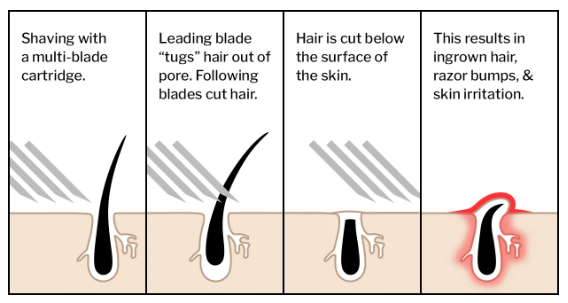
Multiple blades also affect how shaving works, but not always in the way marketing suggests. Each blade passes over the same area of skin, cutting hair incrementally. While this can improve closeness, it also increases skin contact. This is why blade quality and lubrication are more important than blade count alone. Fewer high-quality blades with proper glide can cut hair effectively while minimising irritation, whereas poorly designed multi-blade systems can overwhelm the skin.
Another factor in shaving science is pressure distribution. The best razors are designed to distribute pressure evenly across the cartridge head. This prevents any single blade or edge from bearing too much force. Even pressure reduces the risk of nicks and ensures consistent cutting. Ergonomic handle design supports this by allowing better control and reducing the temptation to press too hard.
Water also plays a role that is often underestimated. Warm water softens hair by allowing it to absorb moisture, making it easier to cut. This is why shaving after a shower often feels smoother. Hydrated hair offers less resistance, which reduces the force needed from the blade and protects the skin. Shaving science is as much about preparation as it is about blade technology.
Modern cartridge systems bring all of these principles together into a single shaving tool. When blade sharpness, geometry, lubrication, and pressure control are properly balanced, a razor can cut hair cleanly without scratching skin. This balance is what separates a comfortable shave from an irritating one, regardless of price or branding.
This is the philosophy behind the design of SmartShave cartridges. By combining sharp, durable blades with effective lubrication infused with Aloe Vera and Vitamin E, the system is engineered to reduce friction while supporting skin comfort during shaving. The result is a shave that feels close and controlled without the harsh after-effects many men associate with daily shaving. When science is applied correctly, shaving becomes less about enduring discomfort and more about consistency and confidence.
Understanding how razors cut hair without scratching skin empowers men to make better grooming choices. Instead of focusing on gimmicks or blade counts, it becomes clear that real performance comes from engineering that respects both hair strength and skin sensitivity. Shaving done right is not aggressive — it is precise, controlled, and supported by science.